
Marketing isn't complicated. But without clarity, even good marketing just creates noise.
Most marketing challenges are not caused by a lack of effort. They are caused by a lack of clarity.
Technology businesses often invest in campaigns, content, events, and lead generation before they have a clear understanding of who they are, why they matter, and how to communicate their value. The result is activity that feels disconnected, inconsistent, and difficult to sustain.
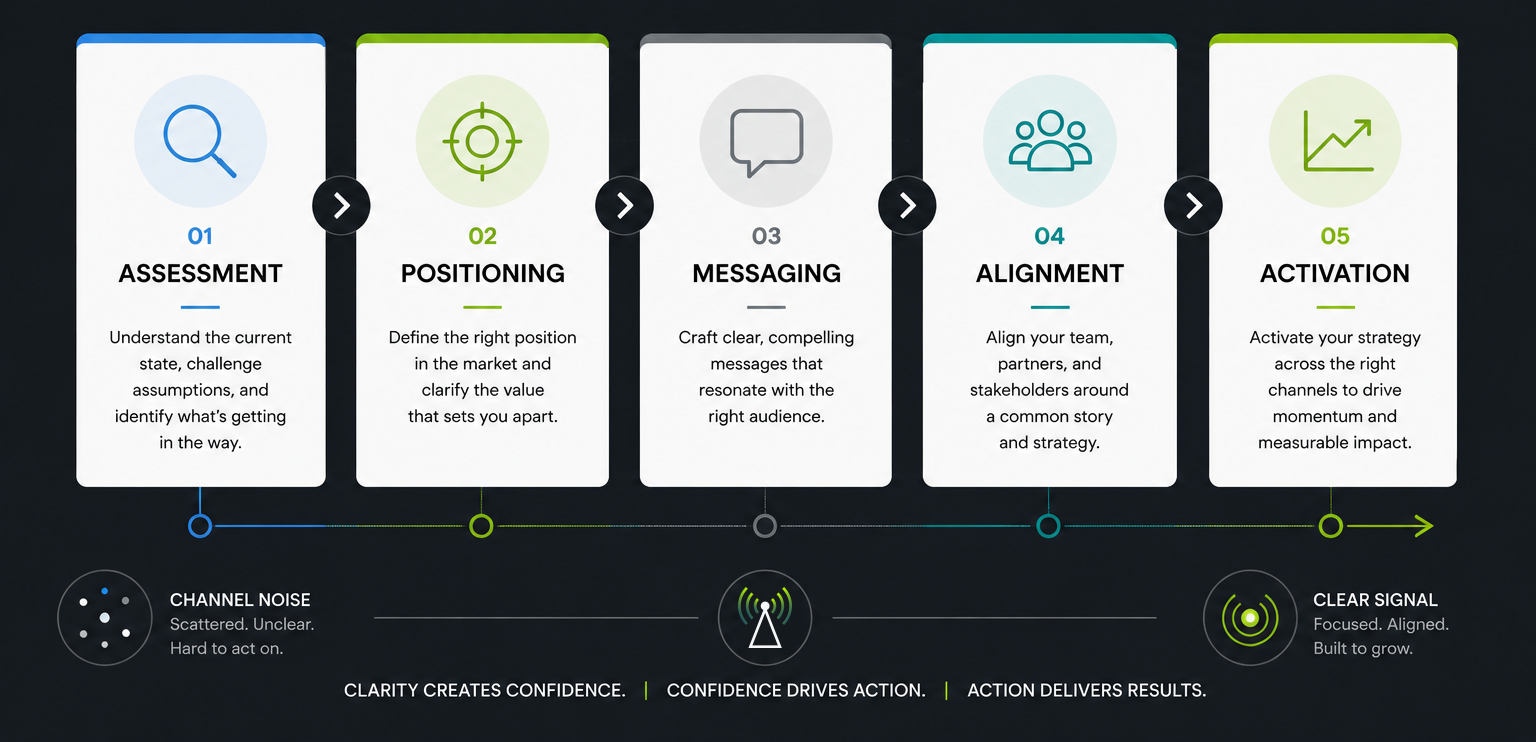
The Clarity Framework is a practical five-stage model for moving from uncertainty to action. It provides a structured approach to understanding the current situation, defining differentiation, building messaging, aligning stakeholders, and activating the market with confidence.
Each stage builds on the one before it, creating a foundation that transforms scattered marketing activity into focused, purposeful execution.
Most marketing problems don't begin with execution. They begin with assumptions.
Assessment is the process of stepping back to understand the current state of the business, the market, and the customer. Before changing messaging, launching campaigns, or investing in new tactics, it's important to understand what is actually creating friction.
• What is preventing growth today?
• How do customers currently perceive us?
• Where are sales and marketing losing momentum?
A clear understanding of the current situation and the obstacles standing in the way of progress.
If you can't explain why you're different, your customers can't either.
Technology businesses often describe what they do but struggle to explain why they are meaningfully different. Positioning creates clarity around who you serve, what problems you solve, and why your approach deserves attention.
• Who are we best positioned to serve?
• What makes us different from alternatives?
• Why should customers choose us?
A clear market position that guides every future marketing and sales decision.
Clarity isn't what you know. It's what other people understand.
Messaging transforms strategic thinking into practical language that customers, sales teams, partners, and vendors can understand. It creates consistency across conversations, presentations, campaigns, and content.
• What story are we telling?
• Is our value immediately clear?
• Would every salesperson explain us the same way?
A messaging framework that creates clarity and consistency across every conversation.
Every inconsistent story creates doubt.
Sales, leadership, marketing, and vendor partners often communicate different messages, creating confusion in the market. Alignment ensures everyone is working from a shared understanding of the business and its value.
• Are teams communicating consistently?
• Does leadership reinforce the same message?
• Are vendors and partners aligned with our story?
A unified narrative that strengthens credibility and reduces confusion.
Great marketing isn't more activity. It's better execution.
Once positioning, messaging, and alignment are in place, marketing becomes easier to execute. Campaigns, content, events, sales tools, and vendor programs all become more effective because they are built on a clear foundation.
• How do we bring the strategy to market?
• What assets and campaigns support the message?
• How do we maintain consistency over time?
Practical execution that turns clarity into measurable business results.
The Clarity Framework helps technology businesses move from uncertainty to action through a practical process that aligns strategy, messaging, and execution.

ChannelSignal explores how technology businesses move from scattered marketing activity to clearer positioning, messaging, alignment, and action.